
What Is Lust?

I’ve finally gotten the nerve to tackle this publicly.

Jesus warned: “You have heard that it was said, ‘You shall not commit adultery.’ But I say to you that everyone who looks at a woman with lustful intent has already committed adultery with her in his heart” (Matthew 5:27-28).

Lust. It’s a universal struggle. And yet I find a widespread lack of knowledge regarding this critical word.

The reason that I want to take this up today is because I believe that the devil loves to get us looking for sin in all the wrong places. That way, we’re almost certain to miss the real stuff.

In the Sermon on the Mount, where Jesus issues the warning about looking at people with lustful intent, He reiterates the Old Testament prohibition against adultery, which we know from the Decalogue (the Ten Commandments) as the Seventh Commandment: “You shall not commit adultery” (Exodus 20:14). Within that specific context, our Lord includes the subject of looking at someone with a certain kind of desire. He is warning against an adultery of the heart.

But don’t miss this: In the serious warning spoken by Jesus, the word translated into English as “lust” is actually the same word that’s used in the ancient Greek translation of the Bible – known as the Septuagint – to translate the word “covet” in the Tenth Commandment: “You shall not covet” (Exodus 20:17). As He connects the Seventh and Tenth Commandments, Jesus explains that lustful intent is the heart-level root of adultery.

So, from the Scriptures, let me be clear.

Our sexuality is not lust.

Our sexual desire is not lust.

Our sexual energy is not lust.

Lust involves something more.

Lust is an insatiable hunger to possess or consume things that don’t belong to us. Things which God has not given us. At the heart of many of our sins is, in fact, the root of greed. We covet. Adultery is an excellent example: “I’ll steal my neighbor’s wife.”

I want to propose today the idea that Christ’s teaching here is grace on steroids. Jesus isn’t imprisoning us in a fear of our own thoughts, but He is inviting us to shift our focus to the real problem: Am I really trusting God to supply what I need? It’s my contention that this theme underlies the entire Sermon on the Mount.

You and I are to treat other people properly and selflessly, and to love them deeply – as we’ve been loved by God. Lust is the antithesis of such love, as lust reduces human beings to mere objects for our own satisfaction. No woman is an object. No person is an object. Lust tells me that God isn’t enough, and that He’s not big enough to take care of me, and to meet my needs, and He really doesn’t want me to be happy at all – so God can’t be trusted. Lust is a liar.

When we come to understand the text in this way, we realize that what Jesus is not attacking us for thoughts that we might entertain, however fleetingly, and for real longings that are actually a perfectly normal part of how God designed us to operate.

God is not anti-sex. It was His idea, after all. What He wants is for us to love and care for others. The way in which He has called us to live for His glory is the way that leads to our deepest joy. God isn’t anti-happiness either. In fact, He’s anything but.

God hardwired us to desire intimacy with others. And God built into us powerful physical and soul-level attractions. Deeply invested in knowing and serving others is how we grow and thrive as human beings.

Misunderstanding lust empowers lust.

When the Bible warns against “the desires of the flesh” (e.g., Galatians 5:17), we’re misguided when we think of “flesh” as simply a reference to our physical bodies. The root of the word is closer to “selfishness” or “self-centeredness.” When you and I fail to understand this correctly, we set ourselves up for a world of harmful doctrine. Authentic Christianity is not ashamed of the physical body, or of the natural desires of the physical body. They’re part of our humanness, and we should thank God for them. To distinguish the spirit from the body in a black-and-white, good-versus-evil manner is closer to the ancient heresy of Gnosticism than to the life-giving gospel of Jesus.

Solid Bible exegesis reveals that, in this life, the spirit and the body are inseparable. Of course, the worship of self is idolatry, and contrary to God’s will for us. But acknowledging the self, and caring for the self, is not sinful. “You shall love your neighbor as yourself” (Matthew 22:39).

One more thing. I think it’s important. Martin Luther said, “You cannot keep birds from flying over your head, but you can keep them from building a nest in your hair.” In my research on the word “lust” in the Bible, I recognized that lust – properly understood – is more than a thought. It is an inclination of the will to secure or act upon some object of our desire.

It’s more than, “Wow! That looks good.”

It’s, “I’m going to have that for myself, and I don’t care who I hurt in order to have it.”

In brutal honesty, as long as we’re still breathing, you and will continue to experience the “Wow! That looks good.” We don’t age out of that this side of heaven.

Do not despise your humanness. Shaming out over your humanness is never the way of Christ, who came to us “fully human in every way” (Hebrews 2:17). For you were created in the very image of God.

Pastor Charles

Posted in Blog Posts

Not Tonight

“Great moments are born from great opportunity.”

It was the opening line of one of the most profound speeches in sports history. Herb Brooks (1937 – 2003), the coach of the 1980 United States Olympic hockey team, encouraged his men in the locker room right before USA faced the Soviet Union at Lake Placid.

I’ve always been a sucker for an underdog story. You may remember it as the “Miracle on Ice.”

Sunday, following their amazing overtime gold medal victory in Milan – with the world watching – Team USA honored the late Johnny Gaudreau by welcoming his children, Noa and Johnny Jr., onto the ice for the official team photograph.

I hope you’re enjoying this moment, friends. Don’t waste it! It’s right and good to celebrate when there’s something good to celebrate. It’s good advice in any season: “Rejoice with those who rejoice” (Romans 12:15).

Few things are more Christlike than a life punctuated by appropriate celebration. Such times of unexpected joy – in whatever manner you and I may get to share in the gold medal moment – lift our weary hearts, lighten our heavy burdens, and fuel us with fresh courage and hope.

I smile when I think of Jesus turning the water into wine at the wedding feast in Cana of Galilee. Jesus tended to R.S.V.P. “yes,” it seems. While He walked this earth, Jesus, the Son of God who’d known fellowship with the angels of heaven, enjoyed dinner parties thrown by tax collectors. We know from Scripture that Jesus was known to have so much uninhibited fun with the people around Him that He was accused of being “a glutton and a drunkard” (Matthew 11:19).

So don’t miss the moment.

The trials and storms and tears of life can certainly take the wind out of our sails. We know that. But to know Christ is to know the rest of the story. The Lord is good, and His goodness can be eclipsed – but not erased. As the startled women learned at the empty tomb: “He is not here, for He has risen, just as He said (Matthew 28:6).”

God’s smiles come in different shapes and sizes.

God’s smiles come from the strangest of directions, and through the strangest of circumstances.

God’s smiles may come in the final hour.

God’s smiles may come in victories which look nothing like victories.

As the Apostle Paul testified: “I count everything as loss because of the surpassing worth of knowing Christ Jesus my Lord. For His sake I have suffered the loss of all things and count them as rubbish, in order that I may gain Christ and be found in Him” (Philippians 3:8-9).

Because it’s true, that sentiment lives on. After Jaccob Slavin of the Carolina Hurricanes scored his first point in the Winter Olympics, he affirmed: “Jesus is everything. He’s Lord of my life. He’s Lord of all my life because if He’s not Lord of everything, He’s not Lord at all. If the Lord wanted to take hockey away from me tomorrow, I’m still good. My identity is not in this sport. My relationship with Christ is the only thing that doesn’t change.”

How can we not celebrate !?!

So don’t miss a single smile.

That locker-room speech went on to unleash the inconceivable: “If we played them ten times, they might win nine. But not this game, not tonight. Tonight, we skate with them. Tonight we shut them down because we can. Tonight, we are the greatest hockey team in the world.”

Thanks, Coach.

Losses come to every life. But not tonight.

Pastor Charles

Posted in Blog Posts

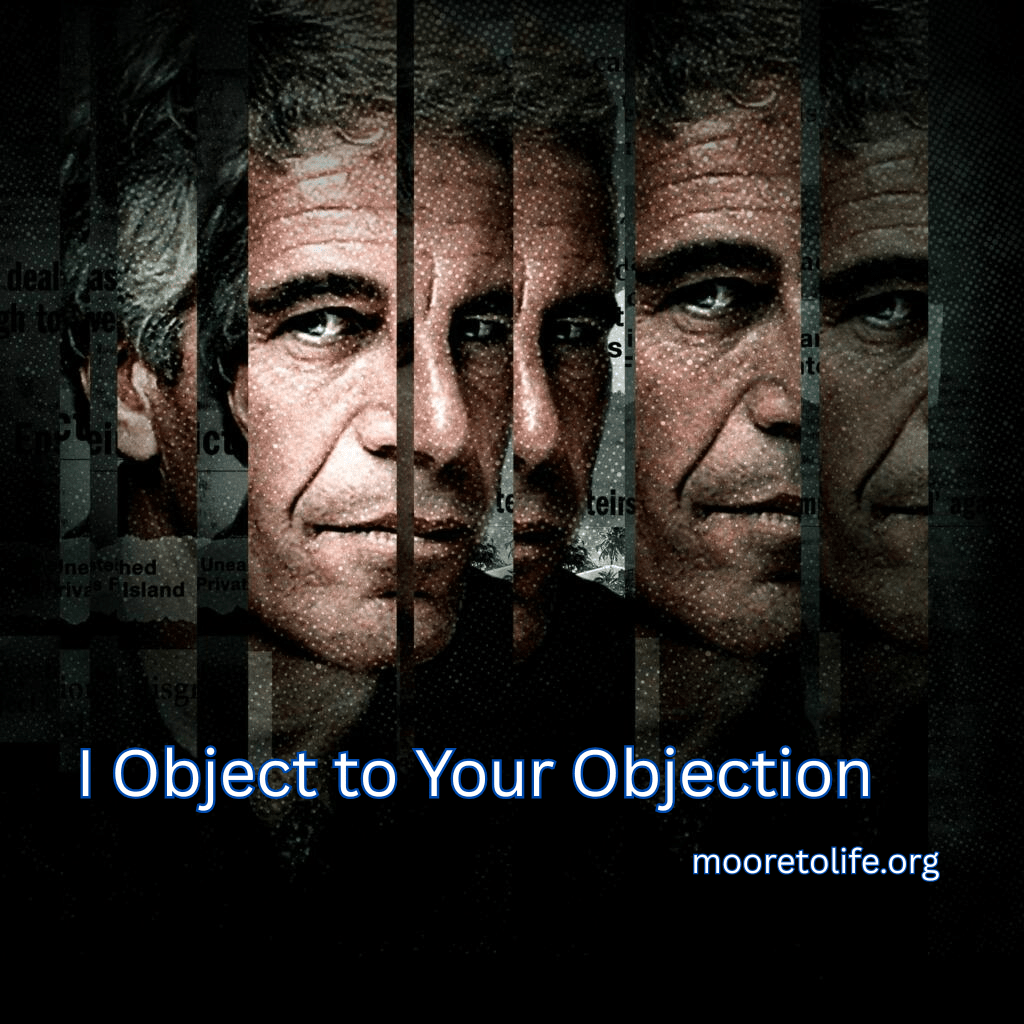
  I Object to Your Objection

I’ve been paying attention to the Jeffrey Epstein fallout. Maybe too much attention, honestly. It grieves me more than just about anything I’ve followed in a long time.

Among recently released files on the website of the U.S. Department of Justice, I read an email dated March 17, 2013 (6:03 p.m.). In the subject line, Epstein titled it “uncensored comments.” It’s a rambling series of complaints about the ways – mostly terrible in Epstein’s mind – in which a certain high-profile charitable foundation made decisions regarding how its money was spent.

One particular objection raised by Epstein caught my eye: “Can’t they come up with a better foundation structure and goal. Then to make the ludicrous statement that every life is equal.”

Wow. Just wow.

Therein may lie the problem.

Therein may lie the darkness.

Therein may lie the fatal flaw.

Friends, it’s in Chapter 1 for a reason: “So God created man in his own image, in the image of God he created him; male and female he created them” (Genesis 1:27).

This one amazing reality has set the stage for human rights in Western Civilization for the past 2000 years. It’s why our nation’s Declaration of Independence insists that “all men are created equal, that they are endowed by their Creator with certain unalienable Rights, that among these are Life, Liberty, and the pursuit of Happiness.” Quite foolishly, many among the “intelligentsia” want to jettison our Judeo-Christian moorings – and, consequently, the truth that we’re created in God’s image. Tragically, as we “exchange the truth about God for a lie” (Romans 1:25), we’re actually erasing the primary justification for treating others the way we all long to be treated: as valuable equals. If there’s no image of God, then some people can be deemed worthless.

In James 3, the precise reason that we’re given by the Bible to not curse another person is because everyone is made in the image of Almighty God. Every single claim to dignity and worth is born of this great truth. To do violence to another person is to strike the beautiful One in whose image they are made. We love our neighbor by honoring God’s own image in them. You and I must never forget that we humans – all of us – are God’s “very good” creation.

Unlike the divine conceptions of many religions – as well as much of our popular entertainment – God is not an impersonal force or the universe expressing itself. God has a mind, a will, and even emotions. He is personal, self-aware, and purposeful. As reflections of Himself, God has graciously granted us the gift of personhood – and uniquely so among all of His created order.

You can be among the elite of the elite and fail to understand this. And the consequences are deadly. God’s Word is crystal clear, as that same chapter in James describes a sophisticated but phony “wisdom” that is in fact earthly, carnal, and demonic in nature. You’ll find that word “demonic” in James 3:15, and it underlies every thought pattern which degrades human beings. Read for yourself. It leads to “jealousy, selfish ambition, disorder, and every vile practice.”

Every. Vile. Practice.

Let me be clear. As a society, we find the Epstein accusations horrific because of Christianity. Before the spread of the gospel, “civilized” Roman and Greek elites indulged openly in underage sex slaves. It was considered normal and acceptable behavior. Emperor Hadrian built an entire city to celebrate his young male lover. But what I most want to note from history is that all such sin has at its heart an attempted erasure of the image of God in us and others.

In “The Weight of Glory,” C.S. Lewis (1898 – 1963) offered us a stirring challenge: “The load, or weight, or burden of my neighbor’s glory should be laid on my back, a load so heavy that only humility can carry it, and the backs of the proud will be broken. It is a serious thing to live in a society of possible gods and goddesses, to remember that the dullest and most uninteresting person you can talk to may one day be a creature which, if you saw it now, you would be strongly tempted to worship, or else a horror and a corruption such as you now meet, if at all, only in a nightmare. All day long we are, in some degree, helping each other to one or other of these destinations. It is in the light of these overwhelming possibilities, it is with the awe and the circumspection proper to them, that we should conduct all our dealings with one another, all friendships, all loves, all play, all politics. There are no ordinary people. You have never met a mere mortal.”

Every life has sacred dignity. Every soul will exist for eternity. Every person has been created for a unique purpose. Eric Liddell (1902 – 1945), the Olympic gold medalist, known to many as “the Flying Scotsman,” expressed it like this: “I believe God made me for a purpose. But He also made me fast. And when I run, I feel His pleasure.” Every believer is gifted of God.

In sharp objection to Jeffrey Epstein’s objection, I take my stand upon the ludicrous truth that every life is equal.

Every. Life.

Every life matters.

Every life matters forever.

As I was preparing this blog posting, it suddenly dawned on me that Jeffrey Epstein wrote the email that I shared with you on Saint Patrick’s Day. How ironic! The man whom we remember as “Saint Patrick” (c. 387 – 461) was the faithful follower of Christ who literally revolutionized the concept of human dignity in Ireland – flowing from there to much of the world. His message of grace was for everyone, as Patrick – a former slave himself, now thoroughly committed to Christ’s liberating gospel – contended that every person possesses intrinsic worth in the eyes of our God and Creator. Patrick believed that the most vulnerable are our equals. He spent his life as a faithful preacher and transformer of culture, advocating tirelessly against all human abuses – including human trafficking.

And Patrick’s prayer fits us well right now …

“May the Strength of God guide us.

May the Power of God preserve us.

May the Wisdom of God instruct us.

May the Hand of God protect us.

May the Way of God direct us.

May the Shield of God defend us.

May the Angels of God guard us.

– Against the snares of the evil one.”

Pastor Charles

Posted in Blog Posts

The Twilight’s Last Gleaming

I’m old enough to remember Whitney Houston’s 1991 performance of our National Anthem. Truly unforgettable. Admittedly, it spoiled me. It also allowed me to really enjoy Charlie Puth’s rendition at yesterday’s Super Bowl LX. Such a class act. The perfectly timed fighter-jet flyover by the U.S. Air Force and Navy was the icing on the cake.

I may be in the minority, but I believe that sporting events – particularly national ones – should unite people (team loyalties notwithstanding). None of us benefits from the politicization of every single subject and moment, which is where we find ourselves right now. It’s exhausting, and we all need a break.

Particularly, I think that God’s people should shoulder some of the responsibility to help redirect the cultural narrative – at least in part. According to Jesus, we’re both salt and light (Matthew 5:13-16).

That’s why I’m directing your attention to Charlie Puth. I’ll include his own words: “Thank you to the Oakland Interfaith Gospel Choir, the Sainted Choir, the Color of Noize Orchestra, Steve Hackman, and Kenny G for joining me on stage. And thank you Adam Blackstone for writing such a beautiful choir part. I love music so much.” I’m sharing that particular quote because I appreciate the incredible collaboration demanded by a spectacular performance like that.

I can’t speak for you, but from my perspective, “collaboration” sounds good right now. I’m all for it. The beauty of America can’t be captured by any one musical style. So I was thrilled that the anthem’s sound was a masterful blend of R&B, soul, and pop. (I’m not a musician, so forgive me if I blur some lines that shouldn’t be blurred. I’m just giving you my take on it.)

I think it honored Whitney, and I think it was supposed to honor Whitney. So it was new, and it was old – at the same time. I hope I’m not making too much of this, but I really believe that America could use more of it right now. A spirit which honors the past and the present – and which sounds a hopeful, warm, intergenerational tone for America’s future. I acknowledge that, when it comes to entertainment, not every song can be “The Star-Spangled Banner.” But I believe that the creative blending of styles serves us well right now.

And this leads me to the main question that I want to pose today: Do we who follow Jesus recognize the unique moment that is ours to make Christ – the one who came to tear down every wall of hostility – known in a world suffering under the crushing weight of division?

I’m not making this up, friends. We serve the Christ who came expressly to destroy “the dividing wall of hostility” that alienated us from God and from each other (Ephesians 2:11-22). “He Himself is our peace.” This is our ultimate spiritual vision for the world! Until that is a reality in all its fullness, you and I are “servants of Christ and stewards of the mysteries of God” (1 Corinthians 4:1).

We are not bigshots. We are servants. We’re on the Lord’s ship, but we’re the under-rowers down below. We don’t get to be the Captain – that spot is filled beautifully – and our worth is derived from the honor and joy that are ours to serve the Captain.

The Captain has entrusted us to steward our responsibilities well. God has drawn us into His work of gospel reconciliation (2 Corinthians 5:11-21). “We regard no one according to the flesh.” That means that we choose to lay aside our preconceptions about others, and regard them as people who need Jesus just like we do – the same Jesus. Among the “mysteries” which we are stewarding is the truth that some of those who show no signs of it now are actually among our fellow heirs to the kingdom of God.

That makes life really exciting! Because it frees us to see people through the eyes of Christ. Among those who look like enemies are some who’ll soon be brothers, sisters, and friends! That’s how it works when the King of the kingdom is full of grace and truth (John 1:14). Christ is building a multicultural community of faith – His Church – strangely but wondrously united under the single banner of His goodness and love.

You and I don’t have to be brilliant or impressive. Christ just wants us to be faithful as we live to make Him known.

So here’s my challenge for you, and for myself. Ask the Lord what is your next step toward living as salt and light in our divided land. Remember what Jesus taught us about our talents (Matthew 25:14-30). We don’t want to bury them. We want to multiply them. We want to multiply the treasure that is in us – the gifts which we’ve been given. We want the Lord to live His life of resurrection victory in and through us (Galatians 2:20)! You and I might not be asked to be part of the pregame show lineup, but we’ve been called to a sphere of influence which is just as valuable in the economy of God.

Super Bowls will come and go. But, year in and year out, may you and I be known as the people of Jesus. Sometimes we have to stand against the darkness, but let’s always make sure that we’re standing FOR the Light!

We know what sin looks like. We’ve seen it on the pages of Scripture. We’ve seen it in the world. We’ve seen it in us. As we advocate against unrighteousness, born out of sheer love for our neighbor, may we with even greater energy advocate for something far greater. After all: “We are ambassadors for Christ!”

The English churchman Thomas Fuller (1608 – 1661) penned the phrase: “It’s always darkest before the dawn.” Perhaps, in America, our Lord will transform the twilight’s last gleaming by the dawn’s early light of an empty tomb.

Pastor Charles

Posted in Blog Posts

Adam, Eve, or Make-Believe?

When it comes to real life, are Adam and Eve any more relevant than Hansel and Gretel?

A leading Christian apologist, beloved in many conservative and evangelical theological circles, now claims that Adam and Eve were non-homosapien cavemen that lived 750,000 years ago.

This view of our first parents is concerning, and I believe it’s loaded with serious implications. And, if you will allow me, I’d like to address a handful of the key implications in the form of “why Adam and Eve matter” …

1. Adam and Eve matter because their real lives begin the record of human history. As a lover of literature, I’m not at all oblivious to the literary styles included within Genesis 1-3. Of course, the account reads as a compelling story – not as a science textbook. I totally get that. In fact, I would make the case that to try to reduce early Genesis to “science” would be to completely miss the main point. The earliest chapters of the Bible are much more important than that. Genesis is the story of the origin of humankind. But let me remind you: Just because it’s a story, doesn’t mean that it’s not true. In fact, it’s entirely true, my friends, because it’s the Word of the living God!

2. Adam and Eve matter because they’re referenced in the Scriptures subsequent to Genesis. And they’re never referenced in a metaphorical sense whatsoever. Instead, the Bible always presents them as actual historical figures. Consider the genealogy of Christ as it’s recorded in Luke 3:23-38. It doesn’t just connect the dots back to Abraham – but all the way to Adam. And consider our Savior’s own words (Matthew 19:4-6; see also Mark 10:6-9): “He answered, ‘Have you not read that he who created them from the beginning made them male and female, and said, “Therefore a man shall leave his father and his mother and hold fast to his wife, and the two shall become one flesh”? So they are no longer two but one flesh. What therefore God has joined together, let not man separate.’” In my opinion, our Lord Jesus validated the historicity of early Genesis.

3. Adam and Eve matter because they underlie many of the Bible’s core doctrinal propositions. By way of example, our first parents are central to our understanding of original sin and the fall of man – which includes the Bible’s clear explanation of humanity’s moral accountability to God. I offer Romans 5:12 as Exhibit A: “Therefore, just as sin came into the world through one man, and death through sin, and so death spread to all men because all sinned –” I don’t see how it’s possible to keep the Bible intact while diminishing the personhood of Adam and Eve. It’s my contention that the veracity of Genesis 1-11 underlies the reliability of the doctrines which follow. Genesis presents Adam and Eve as actual people in a specific place and time. It’s difficult to square an honest reading of the narrative with the idea that Adam and Eve were a pair of hominids elevated to human status. And I don’t see how you can hold to generations of death prior to sin – any kind of death – without undermining essential Christian doctrine.

4. Adam and Eve matter because the gospel is at stake. The Apostle Paul understood Adam to be nothing less than the very first man created by God … the historical figure whose sin universally plunged all humanity into death … the representative moral head of the human race … and a prominent type – a theological pattern – of the Christ who was to come. Paul’s reasoning for the good news of Jesus requires Adam’s historicity (1 Corinthians 15:19-22) – linking Adam’s literal act of pride and rebellion to Christ’s literal, gracious, saving, and redemptive work accomplished by His bloody cross and His gloriously empty tomb!

5. Adam and Eve matter because intellectual approval often comes at a steep price. I know that some apologists seek to squeeze Christian doctrine into a form that’s compatible with modern scientific evidence. But we must be careful not to compromise the truth as God has chosen to reveal it to us. Ultimately, we know that the Bible and science are not at war with each other – in fact, both reflect the glory of our great God. Affirming Scripture doesn’t require a prima facie dismissal of empirical and rational evidence. But I agree with Martin Luther that theology is the “queen of the sciences.” Regardless of the world’s potential applause, we who know Christ must be careful that the cart is not driving the horse. Relegating Adam and Eve to mere symbols of human imperfection would be a fatal flaw.

6. Adam and Eve matter because they teach us an important principle, namely, that the “science” to which many appeal in refuting them isn’t pure science. Many, without realizing it, are appealing completely to philosophy – not science. And some “science” rests entirely on an atheistic worldview. For example, I’ve read a little on the subject of population genetics (bottom line: humans couldn’t have originated from a single couple). These studies depend largely on an evolutionary paradigm, and they’re obviously unvalidated. They don’t adequately take into account variables like population structure, migration, selective mating, and the like. Much of it is, in my opinion, observation with questionable conclusions. Always remember: Mixing atheistic philosophy with theology is inherently dangerous.

7. Adam and Eve matter because they remind each one of us of our human limitations. Though you and I do not, our Lord walks on the water! If we are trusting in a sovereign God who operates above and beyond space, time, and the laws of physical science, then we shouldn’t be the least bit surprised when we reach a place in our study where some things – many things – are beyond our understanding. I believe that some of our questions regarding creation and origins fall into this resoundingly humbling category. From my own study, for example: How were “evening and morning” measured before there was a sun? Admittedly, I still have absolutely no idea, but it really doesn’t matter that I can’t explain that. Our infinite Creator’s supranatural acts are, by definition, way above our pay grade.

I hope that I haven’t bored you with my ramblings today, but I really believe that this matters. Adam and Eve matter. Where our understanding of some of the details leaves us still wondering – that’s precisely as it should be – we can rest in the character of our perfect Christ. You and I don’t have to understand everything right now, and it’s best to stay humble this side of heaven.

Sometimes we’re too smart for our own good. Relying on our own cleverness is a central theme in many fairy tales, including “Hansel and Gretel” and others. Based on our modern sensibilities, James Finn Garner has humorously rewritten the classic tale of “Little Red Riding Hood”: “The wolf said, ‘You know, my dear, it isn’t safe for a little girl to walk through these woods alone.’ Red Riding Hood said, ‘I find your sexist remark offensive in the extreme, but I will ignore it because of your traditional status as an outcast from society, the stress of which has caused you to develop your own, entirely valid, worldview. Now, if you’ll excuse me, I must be on my way.’”

I’m so glad we’re not resting on a fairy tale.

Pastor Charles

Posted in Blog Posts

LIFE: From My Heart to Yours

Thursday I’m off on my annual pilgrimage to D.C. for the March for Life. It’s always great to gather with folks from across the country who believe that all human life is sacred, and that every person – born and unborn – is created in the image of God.

Friends, if you will allow me to share my pastoral experience for just a moment, I’ll let you in on a little-known secret: Unplanned pregnancy can be the richest soil for unplanned grace.

I’m talking about God’s grace, as well as the grace of others. Both expressions of divine love can erupt in the strangest of circumstances – including an unplanned pregnancy – if we will have eyes to see. And I’m convinced that those eyes that we need start deep within our heart (Matthew 6:21-23; Ephesians 1:18).

I’ve learned this: There are accidental parents, but there are absolutely no accidental children. Even when a baby isn’t “planned” by its parents, there are no such surprises for God. Surprised people can find unplanned grace in the midst of the scariness of unplanned pregnancy – even in the most tragic circumstances – but we miss those remarkable blessings unless we look to God to do what only God can do.

Over the years, I’ve talked with a number of women who at some point in their past had made the decision to seek an abortion. Several key themes dominated their stories …

“I thought I was all alone.”

“I thought I had no other options.”

“I was so afraid that I couldn’t think straight.”

When frightened people find themselves there, we must care about these hard realities and the image bearers of God – parents and babies – who are facing them. No one is helped by our dismissive responses or lifeless platitudes. When it comes to the people in our orbit who are hurting and struggling, you and I are to love incarnationally – the way of Jesus – by choosing the hard road of entering into their difficulty and pain. Once we’re there with them – shouldering the burden alongside them – then and only then can we offer them real help and real hope.

The Bible challenges each of us: “Bear one another’s burdens, and so fulfill the law of Christ” (Galatians 6:2).

Friends, when you think about the high calling that’s ours in Christ to “speak the truth in love” (Ephesians 4:15), it can feel overwhelming – especially when the stakes are so high as in matters of life and death. When our neighbors are under the crushing weight of what feel like life’s toughest pressures – in the form of the life-altering decisions which seem to be swallowing them whole – that’s when our gracious presence, witness, prayer, and ministry matter most. It’s a great responsibility to speak the truth and to love at the same time – and one we can’t pull off in human strength.

But you and I are called to lay aside our comfort for the comfort of others. Our marching orders are these: “Rejoice with those who rejoice, weep with those who weep” (Romans 12:15).

Genuine compassion comforts troubled hearts, and you and I are the ambassadors on call. From Christ’s story of the Good Samaritan, I must remember that my “neighbor” is anyone who needs me. Yes, Lord. In the context of an unplanned pregnancy, especially, judging and shaming only fuel the trauma that’s already being felt.

To be pro-life is to be pro-person. You and I are the pro-people people! We can’t forget that. We’re for moms and dads, sisters and brothers, young and old, poor and rich – you name it. We’re pro-life and pro-people. Whatever the category, our call is to love. We want all people to thrive.

To thrive in Christ.

We’re called to love those facing an unplanned pregnancy, and to love those facing the regret – another real trauma – of an abortion. We all need the Sovereign Lord to enlarge our heart, as everyone needs to experience the lavish love of God. I’m so glad that God’s lavish love includes God’s lavish forgiveness.

Such undeserved grace is to be our heart posture toward others as well: “Forgive and comfort” (2 Corinthians 2:7).

If you don’t consider yourself to be “pro-life,” perhaps we can simply agree that every person has dignity and worth. It’s a place to start, at least, and such a shared acknowledgment creates an atmosphere in which dialogue and goodwill can be extended in every direction.

From my heart, friends, I reach out to you and share these things in the love of Jesus.

Pastor Charles

Posted in Blog Posts

Any Room Left for Truth?

Lots of issues hold space on America’s table. Immigration. Sex and gender identity. Men in women’s sports. Identity politics. Globalism. Racism and Kinism. Antisemitism. Eugenics and human life. Assisted suicide. The economy and the national debt. Bridging our widening divide. Power and authority. The role of the church in society.

My head is spinning. Yours?

The Scriptures instruct Christ followers to “avoid foolish controversies” (Titus 3:9). I interpret that as a call to discern as you and I form various and sundry positions on various and sundry subjects under the sun. Moreover, it’s a call to be wise in what we say and how we say it.

For us, some conversations – whether in-person or online – are unprofitable at best. At worst, they impair our witness for Christ, fuel unnecessary fires of conflict, and damage relationships with our fellow image bearers.

So we proceed with humble caution.

But, as we do so, I want to make sure that we’re not leaving our Bible on the shelf.

It is such a temptation in these days of instant access to endless information to get our cues from everyone other than God. That would be a tragic mistake, and it’s one that we can fall into without recognizing it. After all, we’ve read the Bible before … but this riveting new post on social media really catches our eye! I’m sure you know what I mean.

The Bible is our perpetual reminder that God has spoken! God. Has. Spoken.

God’s Word is not always given to me to prop up whatever I already believe to be true. Sometimes the Spirit uses it to stop me in my tracks. To show me the error of my ways – my sin. To convict me in regard to just how deeply wrong I’ve been on this subject or that.

Such spiritual challenge – deep within my soul – is a great gift from our gracious Lord. But it won’t be mine if I don’t take the Bible seriously. The Bible is my ultimate authority, you see. If I fail to protect that loyalty, my preferences or politics or proclivities will steadily make their way into the place of prominence that was supposed to be reserved for the Word of God.

Since “faith comes from hearing, and hearing through the word of Christ” (Romans 10:17), this principle is all-important. You and I are on a battlefield of ideas, every day. We’re never off-duty. Paul reminds us that our critical spiritual armor includes “the shield of faith, with which you can extinguish all the flaming darts of the evil one” (Ephesians 6:16). Think about it. When the Bible – in regard to the issues of the day – isn’t prominent in our thinking and reasoning, we’re trying to hold up a shield with holes in it! A defective shield. We’re ill-equipped for life’s challenges, our defenses are weakened, and we’re vulnerable to satanic deception.

The Bible is the authority by which every other claimed “authority” stands or falls.

Sadly, what I see on the broad landscape of American evangelicalism is disturbing. It is alarming. It is unnerving. People who claim to be God’s people are abandoning our infallible supply of needed strength. Bailing on our rightful authority. Perhaps not intentionally or even consciously, they’re more often siding with the truth claims of the world. If you ask me, it’s a less obvious clone of the same monster that ate the mainline denominations alive within my own lifetime.

I want to say one more thing about the war for truth. It’s the war that you and I are in, Beloved – whether we like it or not. Yes, we’re consigned. But the war for truth is also the war for love. You see, friends, truth and love aren’t at odds with each other. Love and truth aren’t enemies. The very nature of our risen Christ proves this unquestionably, as He came to each one of us “full of grace and truth” (John 1:14).

We will never win to the cause of our God of truth a world that we despise. Never. You and I must love broadly and indiscriminately – just as we have been fully loved. This is the way.

And it’s the only way.

“What is truth?” asked Pontius Pilate (John 18:38). It’s a question God already answered.

Pastor Charles

Posted in Blog Posts

For Such a Time as This

As I watch events unfold in Venezuela, Iran, and in nearly every other part of the world, I’m reminded of the immeasurable blessing that is freedom of speech. What we still enjoy in America is unique, and should not be taken for granted.

I’ve written on this subject before, and I always anchor my argument for robust free speech in our being created in God’s image (Genesis 1:27). For me, free speech starts and ends there. It’s a function of our distinct personhood and a reflection of the goodness of Almighty God. I hope that it goes without saying that you and I should not only desire free speech for ourselves, but for everyone else.

We who follow Christ champion the sanctity of human life, and that includes our commitment to the common good. There are no fundamental human or civil rights where self-expression is forbidden or – even worse – punished. Christians are called to be truth seekers. As such, we’re to defend the basic liberties which promote human flourishing in the form of free expression.

Free speech is a shield against tyranny. This is a global reality.

I’m alarmed by the loss of free speech that I see happening in England, as well as in Canada. These injustices hit close to home, and include punishment for activities like holding a sign, or wearing a t-shirt, or praying publicly – even silent prayer. What would have been considered unthinkable restrictions in such Western societies just a few years ago are now being codified and enforced in short order.

My concern is that you and I not sleep through this erosion of freedom, but that we remain watchful, prayerful, and vigilant for such a time as this. As 2026 gets rolling, I’m asking you to join me in praying daily for our sisters and brothers in many parts of the world who are seeking to follow Christ under harsh governments which work actively against even the one-to-one sharing of the good news of Jesus. Anywhere on Planet Earth, where freedom of speech is lost, so is freedom of religion. Personally, I’m praying for fifteen specific countries so that my awareness of persecution is a little less theoretical and a little more tangible.

I don’t advocate for freedom of speech only in the hope that burdensome legal restraints are eradicated, but in the hope that people from every nation – our fellow image bearers – may enjoy what it means to be fully human. My hope is deeply theological. Freedom of expression aligns beautifully with enjoying the fullness of God, in whose image each one of us was created. You and I are free for God’s glory – not for our own.

We serve the God who champions freedom: “Let my people go!”

We serve the God who spoke – literally – the entire cosmos into being (Genesis 1:3, 6, 9, 11, 14, 20, 24, 26). No less the Creator of everything that exists – seen and unseen – our Lord Jesus Christ is none other than “the Word” who graciously invaded space and time to rescue and redeem us (John 1:1-3; Colossians 1:15-17). We look to Him who creates to sustain.

Words matter. Every word matters. The gospel transforms the world primarily through speech.

This truth is often overlooked, but the government does not grant anyone free speech. Honorable government merely acknowledges what our Creator has already declared to be true. Per God’s Word, the authority of all human government is purposefully limited (Romans 13:1-7; 1 Peter 2:13-17). Thankfully, in America, freedom of speech is recognized and protected in our earliest documents. But you and I’d be foolish, here and now, to fail to seek the risen Lord to uphold us – for our good and for His glory.

We must never forget that the aim of all speech is love for God and others. When I was a young seminarian, one of the highlights of my studies was getting to meet Carl F. H. Henry, who had a profound understanding of the important intersection of Biblical doctrine and politics. Rightly, Dr. Henry challenged both liberal social gospel and conservative retreat from the public square. I’ll share just one critical quote: “The Bible has a doctrine of divinely imposed duties; what moderns call ‘human rights’ are the contingent flipside of those duties.” Said differently by me: God liberates us – by His undeserved grace – so that we can be free to serve a world imprisoned by sin and spiritual darkness.

You and I are free to serve. In fact, freedom calls us to responsibility. Communication is one of the many gifts which God has given us to point the whole world toward eternal truth, justice, righteousness, and love. Free speech is much more than a matter of political or social justice, as it enables people to thrive in joyful conformity to God’s call upon our lives.

Of course, some speech can be intrinsically and utterly destructive (Proverbs 18:21). We have to act when speech itself causes imminent harm, but it’s my contention that speech should enjoy the general presumption of liberty. Restrictions on speech should be the rare exception – certainly not the norm. All governments by nature drift toward more power for themselves, so it’s incumbent upon citizens of good faith to keep the First Amendment alive and well.

We have the greatest opportunity to arrive at the truth when speech is free (Isaiah 40:1-8; 55:10-11; Matthew 12:33-37; John 10:27). I’ll quote a great proponent of the value of the marketplace of ideas, Justice Oliver Wendell Holmes, Jr. [U.S. v. Schwimmer, dissenting opinion]: “If there is any principle of the Constitution that more imperatively calls for the attachment than any other, it is the principle of free thought – not free thought for those who agree with us but freedom for the thought that we hate.”

Where people are free, we can feel the wind of heaven. On a fallen planet, personal liberty can function like a grace-oasis. Long after Moses, the Passover continued to be the people’s reminder that God wanted them free. So it is with our Holy Communion. You and I have it on excellent authority: “So if the Son sets you free, you will be free indeed” (John 8:36). Hallelujah! And the liberty which our souls crave we should desire for others. This is love.

Finally, I’ll quote Dr. Wayne Grudem, whose “Systematic Theology” has become so life-giving to the young people in our church: “Protecting people’s ability to think and decide issues freely for themselves means that they must be able to have access to arguments on all sides of an issue. This can only happen if freedom of speech is permitted in a society and if all the different viewpoints on an issue are able to be freely expressed.”

I say let’s keep the light on.

Pastor Charles

Posted in Blog Posts

For Auld Lang Syne

The new year is upon us.

It’s the season for thinking about the big picture of our lives – and for flying a little higher to gain a better perspective on it all. I want my life to count. To really count. I suppose we all do, and there’s nothing like the ring of “Happy New Year” to get us thinking about it even more.

There’s really no moving forward without at least a little looking back. In his timeless classic, the Scottish poet Robert Burns (1759 – 1796) penned it like this …

“Should auld acquaintance be forgot,
and never brought to mind?
Should auld acquaintance be forgot,
and auld lang syne?”

“Auld lang syne” is a Scots phrase that literally translates to “old long since,” but has taken on more contemporary meanings like “for old time’s sake” or “for the good ole days.” The famous song, taken on by artists from Beethoven to Mariah Carey, reflects upon friendships that have stood the test of time. It starts with a rhetorical question: “Should old acquaintance be forgot?” “No” is the desired answer, clearly. You and I shouldn’t forget, but we should remember fondly the important relationships with which we’ve been blessed.

The Apostle Paul reminds us in more than one passage to be grateful for one another. We are God’s grace-gifts to each other (Romans 12:3-8; 1 Corinthians 12:4-11), as we strive to serve one another in the love of Christ.

But Paul also reminds us that our greatest connection is not to each other – it’s to Christ Himself! “For no one can lay a foundation other than that which is laid, which is Jesus Christ. Now if anyone builds on the foundation with gold, silver, precious stones, wood, hay, straw – each one’s work will become manifest, for the Day will disclose it, because it will be revealed by fire, and the fire will test what sort of work each one has done (1 Corinthians 3:11-13).

As we begin a new year, this is a powerful metaphor – a timely admonition and encouragement – for us. How we live our lives in 2026 ought to be worth some front-end time, consideration, and prayer on our part. In Christ, we’re members of His body, being built up numerically – but that’s not the most important point. We’re to be growing always in spiritual maturity – that’s our high calling – individually and as a community of believers. Christ’s Church is an ongoing construction project on this side of glory – “Pardon the Mess” – but we’ll never be any stronger than our singular foundation: Christ! He’s both the Cornerstone and the Master Builder.

How you and I choose to build on that foundation counts for eternity, friends. Will we build well? Will we seek the Lord for reliable building materials like gold, silver, and precious stones? Will we rely humbly on Christ’s strong, sturdy, and invaluable resources of grace and truth, or will we try foolishly to get by on our own?

Remember: There’s only one Master Builder! He doesn’t need you or me to run the project. He calls us, by His might and for His glory, to raise a splendid edifice that will stand the test of time – a sturdy and glorious and timeless spiritual house – built by bricks of faith entirely in Him.

Wood. Hay. Straw. Forget it. We want no part of that. A spiritual life that is cheap or achieved without blood, sweat, and tears – what a waste of time! And, let’s face it: The time is short. 2050 is closer than 2000.

The day is coming when all will be revealed. You and I will answer to God, and give an account. If we’re standing strongly on that day, it will be because we’re still standing on the risen Lord Jesus Christ.

Don’t move away from that sure foundation.

Don’t settle for the easy way out.

Don’t cut corners. Matthew 7:24-27.

It’s super easy to define ourselves by what we see in the mirror … by our ancestry or heritage … by our perceived level of education … by our vocation or occupation … by our possessions or stocks or the money we have in the bank … by our ethnicity or reputation or whatever else. It’s easy to compare ourselves to others and either think too much or too little of ourselves. It’s easy to stay stuck in our past sins or regrets or shame.

But, if we’re in Christ, none of that is our true identity. Our true identity is in Jesus Christ. Nothing in this world defines us like Christ.

Maybe 2026 is the year when we’ll finally agree with God about that. If so, may it be a year of  tearing down the old so that we can celebrate the new!

After all, because of a bloody cross and an empty tomb, you and I belong – forever and ever – to the living God.

There will be some surprises in the new year. There will be some sadness. There will be some suffering. And there will be some joy! In fact, I pray lots of joy for you!

Our hope isn’t in the new year, but in the Christ who came to make all things new.

So cherish your friends. They’re all irreplaceable. And make some new friends in the new year. You’ll be glad you did. Choose to see God’s goodness in each one.

And remember that the love we feel “for auld lang syne” – as we enjoy and give God praise for our human relationships – merely points to the greatest love.

Pastor Charles

Posted in Blog Posts

CHRISTMAS: Foretaste of Glory

I love Christmas.

But.

This Christmas will feel a little – or maybe a lot – weird. Mom is gone, and that’s a colossal loss. I’m not sad for her, but I’m sad for us. Christmas was her favorite time of year, and she always made it special for everybody. Perhaps you are – or were – blessed with a mother like that.

So the sights, sounds, smells, and delights of Christmas 2025 are hitting me a little differently. The lights are beautiful, but I sure miss driving Mom around to point out the best ones. Even the Opryland Hotel – gorgeous as it is – isn’t shining quite as brightly for me. All the familiar carols are merry, but any one of them can spark instantaneously a vivid memory that makes me long for yesterday.

If you know me, you won’t be surprised to hear that I love the aroma of holiday delicacies – maybe a little too much lol – but nobody on Earth makes fudge like Mama’s. That too is gone. And to be quite honest, every moment of the season – even the extraordinarily happy ones – brings with it a potential shadow of sadness.

I don’t mean to depress you. I don’t want to depress myself either. Christmas is still wonderful – it’s just not perfect. And I think it’s imperfect for a very critical reason.

Christmas is a foretaste of glory, you see. It’s the tasty appetizer before the delectable entrée that’s coming. It’s the prelude to eternity, and the dawn of our deepest joy. It’s flavorful – yes – but not nearly as wonderfully scrumptious as the main event that’s certain to follow.

Even our best Christmas is imperfect because deep within is us there’s an awareness that we’re still longing for something more. The truth of Christ’s Incarnation – “God with us” (Isaiah 7:14; Matthew 1:23) – gives great hope to our darkest day, but it also reminds us that earthly joys are mere echoes. They’re never ends unto themselves.

Deep within us, we’re longing for home. Home home. The sights and sounds and smells and delights here point in a more permanent direction. Each flicker of temporal joy in part illumines the ultimate reality that is ours in Jesus Christ! You and I weren’t made to live here forever. Even our happiest moments here serve to awaken in us an unquenchable longing for a world where sin and separation will be no more.

Christmas makes us homesick for another world – a perfect world. The joy, beauty, and wonder of Christmas are temporary glimpses of far greater realities, helping us embrace the truth that this world is not where we ultimately belong.

In Christ, you and I are headed to a place so perfectly exquisite and satisfying to the very core of who we are that the merriest day here is but a sampling of the glory that’s coming (John 14:1-6; 2 Corinthians 3:18).

Sometimes our thirst for those distant shores is less evident than we sense it at other times, but you and I are always longing for God – to see and know Him as He is. And we are longing to be with our loved ones in a place where everyone will be whole. It’s coming, my friend! And “so we will always be with the Lord” (1 Thessalonians 4:17).

You see, regardless of what may appear on our Christmas list, our deepest desires aren’t for earthly things – but for God Himself. Christmas, with its focus on the divine entering the human, awakens our innate hunger to be home at last in our “true country” (Hebrews 11:13-16) – and I’m telling you it’s just over the horizon!

I’m so glad that Jesus was willing to enter into our broken world. That changed everything. Christ has shown us the fullness of the love of God, and how we are to live each day in the light of that magnanimous love. Christmas tells our story, and it’s the story of the already and the not yet – held together simultaneously and securely by God’s grace.

Our past is His. Our present is His. Our future is His.

So all is well. Christmas is good, and it points to the best. We have it on excellent authority: “God … will dwell with them, and they will be His people, and God Himself will be with them as their God. He will wipe away every tear from their eyes, and death shall be no more, neither shall there be mourning, nor crying, nor pain anymore, for the former things have passed away” (Revelation 21:3-4).

Our neighbor here in Franklin who loves Christmas with unbridled passion, Matthew West, sings these tender lyrics to the Lord …

“And it took me back to 8-years-old
My Daddy’s hand and a story told
About Heaven’s love and the manger lo
And a promise that’s still true

You’re still the hope of Christmas
You’re still the light when the world looks dark
You’re still the hope of Christmas
And You’re still the hope of my heart.”

So, if for you this Christmas feels a little bit like, “This is not quite it,” that’s a really good thing. Because it’s not quite it! That’s why the post-Christmas letdown, when the holiday hype fades, isn’t just about leftover tinsel and trimmings and all the rest. It’s the human soul’s stark realization that this world can’t completely satisfy (Ecclesiastes 3:1, 4, 11). And it points us to the ultimate satisfaction that will be ours on the day when Christ comes again!

“He comes to make His blessings flow far as the curse is found.”

The humble arrival of Jesus captured by the timeless Christmas story invites our humble worship of the King of Kings! So enjoy all the parts that you can. Choose with me to believe that this Christmas season can help each one of us walk by Christ’s Spirit into a deeper place of reverence and awe, where – because of the built-in imperfection – our deepest longing can grow and flourish. It’s the longing to be home with our God and home with our forever family.

Home is where we’re headed. Home home.

I can almost taste it.

Pastor Charles

Posted in Blog Posts